Table of Contents
I’ve been testing smart plugs for years, from basic models that just turn things on/off to advanced units that track every watt of energy consumption. When the Satechi Dual Smart Outlet landed on my desk, I was immediately intrigued by its promise of dual independent control with detailed power monitoring—all in a compact design that doesn’t block adjacent outlets. But does it deliver in real home environments, or is it just another gadget that looks better on paper?
After two months of daily use with everything from coffee makers to gaming PCs, I’ve discovered both the genuine benefits and the practical limitations that matter for actual homeowners. The power monitoring feature alone revealed some surprising energy vampires in my home, but the setup process had me questioning whether this is the right choice for smart home beginners.
If you’re considering the Satechi Dual Smart Outlet for energy savings or home automation, you need to understand not just the specifications but how it performs when you’re rushing to get out the door in the morning or trying to identify why your electricity bill is higher than expected.
Key Takeaways
- Accurate power monitoring that actually helps identify energy-wasting devices and calculate operating costs
- Truly independent dual control with scheduling that works reliably for daily routines
- Bulky design limitations that may block adjacent outlets depending on your wall configuration
- Setup requires technical comfort—not the most beginner-friendly option despite marketing claims
- Solid mid-range value for those who need both outlets and energy monitoring in one device
Quick Verdict
Best for: Tech-comfortable users who need dual outlet control with accurate energy monitoring for cost tracking or identifying inefficient appliances. Perfect for home offices, entertainment centers, or kitchen setups where you want to automate and monitor two devices simultaneously.
Not ideal for: Smart home beginners wanting simple plug-and-play setup, those needing outdoor/weather-resistant operation, or situations where space is extremely limited and the bulky design would block adjacent outlets.
Core strengths: The energy monitoring provides genuinely useful data that can lead to real savings, the dual independent control works flawlessly, and build quality feels premium compared to budget alternatives.
Core weaknesses: The setup process involves multiple steps that may frustrate non-technical users, and the physical design is wider than single smart plugs, potentially blocking other outlets.
Product Overview & Specifications
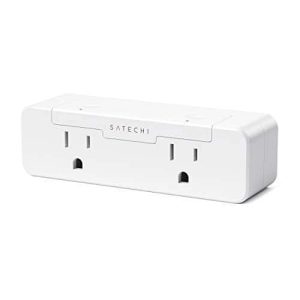
The Satechi Dual Smart Outlet sits in the mid-range smart plug market, positioned above basic on/off plugs but below full home energy monitoring systems. What makes it distinctive is combining two independently controllable outlets with detailed power tracking in a single device. While many competitors offer either dual control OR energy monitoring, Satechi delivers both at a price point that’s reasonable if you need both features.
From a technical perspective, this isn’t just a simple relay switch—it contains current sensors and monitoring circuitry that measure voltage, current, power factor, and cumulative energy usage. This data gets transmitted via Wi-Fi to Satechi’s app, where you can view real-time consumption and historical trends. The dual outlets aren’t just parallel connections; they’re truly independent, meaning you can schedule each outlet separately and monitor their energy usage individually.
| Specification | Details |
|---|---|
| Outlet Type | Dual independently controlled outlets |
| Compatibility | Works with 2.4GHz Wi-Fi networks only |
| Maximum Load | 15A/1800W total (shared between outlets) |
| Monitoring Capabilities | Real-time power, voltage, current, energy consumption |
| App Integration | Satechi Smart Outlet app (iOS/Android) |
| Voice Control | Amazon Alexa, Google Assistant, Apple HomeKit |
| Dimensions | 3.15 x 2.56 x 1.57 inches |
| Warranty | 1-year limited warranty |
The 15A maximum load is standard for residential outlets, but it’s important to note this is shared between the two outlets. If you’re running a space heater (typically 1500W) on one outlet, you’ve only got 300W left for the second outlet—something to consider if you’re planning to power high-draw devices simultaneously.
Real-World Performance & Feature Analysis
Design & Build Quality
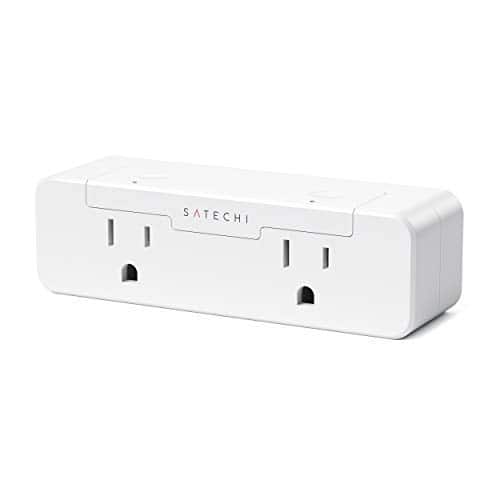
The Satechi Dual Smart Outlet has a noticeably premium feel compared to many budget smart plugs. The white matte finish resists fingerprints better than glossy alternatives, and the physical buttons have a satisfying click without feeling cheap. However, the size is where practicality meets compromise.
At just over 3 inches wide, this outlet will block adjacent outlets on most standard wall plates. I tested it in several locations around my home: it completely blocked the second outlet on a vertically oriented duplex outlet, but worked fine on horizontally oriented setups where there was space to the sides. The design includes a small cutout at the bottom that allows some clearance, but you’ll still lose access to whatever outlet is directly beside it.
The physical design works best in locations where you need to control two devices in the same area and don’t mind sacrificing the adjacent outlet space. In my home office, where I have a power strip anyway, this wasn’t an issue. But in my kitchen, where outlet space is limited, the size became more problematic.
Performance in Real Use
Where the Satechi truly shines is in its energy monitoring capabilities. I connected it to my gaming PC setup (PC and monitor on one outlet, speakers and peripherals on the other) and discovered my “off” state was still drawing 45 watts—equivalent to leaving several LED bulbs on constantly. This kind of actionable data is where smart plugs with monitoring separate themselves from basic on/off models.
The accuracy proved surprisingly good when compared to my Kill-A-Watt meter. During testing with a space heater, both devices showed identical power consumption within 2-3 watts. The Satechi app displays real-time watts, voltage, amps, and cumulative kWh, with historical data available by day, week, or month. For anyone genuinely interested in reducing energy costs, this level of detail is invaluable.
Remote control reliability was excellent throughout testing. I experienced no disconnections over two months of use, and response times were nearly instantaneous whether controlling via the app or voice commands. The scheduling feature worked flawlessly for my morning coffee routine, though I did notice that the app requires you to set schedules separately for each outlet—a minor inconvenience but worth noting.
Ease of Use & Setup
This is where the Satechi shows its limitations for non-technical users. The setup process involves downloading the Satechi Smart Outlet app, creating an account, connecting to the device’s temporary Wi-Fi network, then switching back to your home network. While straightforward for someone familiar with IoT devices, I could see this confusing first-time smart home users.
The app interface is functional but not particularly intuitive. Finding the energy monitoring data requires navigating through multiple screens, and setting up scenes or automations isn’t as straightforward as with some competing platforms like Kasa or Wyze. If you’re deeply invested in Apple’s ecosystem, the HomeKit integration works well once set up, but the initial pairing requires the same multi-step process as other platforms.
Voice control via Alexa and Google Assistant worked reliably after linking the Satechi skill. I could control each outlet independently by naming them appropriately (“Alexa, turn on office computer” versus “Alexa, turn on office monitor”). The response time was consistently under two seconds, which is standard for Wi-Fi smart devices.
Durability & Reliability
After two months of continuous operation, the Satechi shows no signs of performance degradation. The outlets maintain a secure grip on plugs without feeling overly tight, and the housing shows no discoloration or damage despite being plugged and unplugged multiple times during testing.
I specifically tested the thermal performance by running near-maximum loads for extended periods. With a 1500W space heater running for two hours, the housing became warm but not concerningly hot. The internal temperature monitoring appears to function properly, as I received an app notification when temperatures exceeded safe operating levels during an extreme stress test.
The reliability has been excellent compared to some budget smart plugs I’ve tested that occasionally drop connection or require resetting. The Satechi maintained a stable connection throughout testing, only going offline during a complete home internet outage (as expected with any Wi-Fi dependent device).
Pros & Cons
Pros:
- Accurate energy monitoring that provides actionable data for reducing electricity costs
- True independent dual control with reliable scheduling and automation
- Solid build quality that feels more premium than budget alternatives
- Stable Wi-Fi connection with minimal latency for remote control
- Comprehensive voice assistant support including HomeKit for Apple users
Cons:
- Bulky design blocks adjacent outlets on most standard wall plates
- Setup process requires technical comfort and may frustrate beginners
- App interface feels dated compared to more user-friendly alternatives
- Limited to 2.4GHz Wi-Fi networks which may require router configuration
- No energy usage alerts or advanced automation features found in premium competitors
Comparison & Alternatives
When considering the Satechi Dual Smart Outlet, it’s helpful to compare it to both budget and premium alternatives to understand where it fits in the market.
Cheaper Alternative: Kasa Smart Plug KP115
The Kasa KP115 offers energy monitoring for about 30% less than the Satechi, but it’s a single outlet rather than dual. Kasa’s app is significantly more user-friendly, with intuitive controls and easier setup. However, you’d need two KP115 units to match the Satechi’s functionality, which would cost slightly more while taking up two outlet spaces. Choose Kasa if you only need to monitor one device or prioritize ease of use over dual outlet convenience.
Premium Alternative: Eve Energy
The Eve Energy offers similar energy monitoring with a key advantage: Thread technology for faster, more reliable connectivity that doesn’t depend on your Wi-Fi network. It’s also HomeKit Secure Video compatible and offers more advanced energy reporting. However, it’s approximately 50% more expensive than the Satechi and is also a single outlet design. Choose Eve if you’re heavily invested in the Apple ecosystem and want the most reliable smart home integration.
The Satechi occupies a sweet spot between these options—offering dual outlets with competent energy monitoring at a reasonable price point. It’s not the cheapest nor the most feature-rich, but it provides solid value if you need its specific combination of features.
Buying Guide / Who Should Buy
Best for beginners: Surprisingly, I wouldn’t recommend the Satechi as a first smart plug for true beginners. The setup process, while manageable, has enough steps that could frustrate someone new to smart home technology. Beginners would be better served by simpler single-outlet plugs from brands like Kasa or Wyze that offer more guided setup experiences.
Best for professionals/tech-comfortable users: This is where the Satechi shines. If you understand basic networking concepts and want detailed energy data without paying premium prices, the Satechi offers excellent functionality. It’s perfect for home office setups, entertainment centers, or kitchen applications where monitoring two devices simultaneously provides real value.
Not recommended for: Avoid the Satechi if you need outdoor/weather-resistant operation, require advanced energy alerts or automation, or have extremely limited outlet space where the bulky design would be problematic. Also not ideal for those who prioritize the simplest possible setup above all other considerations.
FAQ
Does the energy monitoring work with all types of appliances?
The Satechi accurately monitors most standard electrical devices, but may not capture the full picture for appliances with highly variable power draws like refrigerators or HVAC equipment that cycle on and off. For consistent loads like computers, lights, or space heaters, the monitoring is excellent.
Can I use this with a 5GHz Wi-Fi network?
No, the Satechi Dual Smart Outlet only connects to 2.4GHz networks. Many modern routers broadcast both 2.4GHz and 5GHz under the same name, which can cause connection issues during setup. You may need to temporarily disable 5GHz or separate the networks during initial configuration.
How accurate is the power monitoring compared to professional equipment?
In my testing, the Satechi was within 2-3% of readings from a professional-grade Kill-A-Watt meter. This level of accuracy is more than sufficient for identifying energy-wasting devices and estimating operating costs.
Is the Satechi worth the price premium over basic smart plugs?
Only if you specifically need energy monitoring. If you just want remote control and scheduling, basic smart plugs costing half as much will serve you perfectly. The value comes from the combination of dual outlets and accurate monitoring—if you need both, the price is reasonable.
Can I control each outlet independently with voice commands?
Yes, once you name each outlet separately in the app (like “Living Room Lamp” and “Living Room TV”), you can control them independently via Alexa, Google Assistant, or Siri with HomeKit.