Table of Contents
- Key Takeaways
- Quick Verdict
- Product Overview & Specifications
- Real-World Performance & Feature Analysis
- Design & Build Quality: The Field-Ready Tank
- Optical Performance: Where It Really Shines
- Ease of Use: The Handheld Compromise
- Pros & Cons
- Comparison & Alternatives
- Cheaper Alternative: Sigma or Tamron 150-600mm f/5-6.3
- Premium Alternative: Nikon 500mm f/5.6E PF ED VR
- Buying Guide / Who Should Buy
- Best for Beginners
- Best for Professionals
- Not Recommended For
- FAQ
You’re standing at the edge of a marsh at dawn, the air cool and still. A great blue heron is hunting in the distance, a silhouette against the rising sun. You raise your camera, but even at 300mm, the bird is a mere speck in the frame. This is the moment you understand the need for a true super-telephoto lens. The Nikon 200-500mm f/5.6E ED VR was built for exactly this scenario, offering serious reach without requiring a second mortgage. But in a market crowded with third-party 150-600mm options, is this Nikon-native lens still the right choice for the dedicated enthusiast?
I’ve hauled this lens through rainforests, tracked birds in flight for hours, and used it for everything from youth sports to astrophotography. This isn’t a spec-sheet rundown; it’s a practical guide based on the realities of using this lens when the light is fading, the subject is moving, and you need results. Let’s break down where the 200-500mm truly excels and where you might want to consider an alternative.
Key Takeaways
Before we dive deep, here’s the essential insight from months of real-world use:
- Outstanding Sharpness for the Price: The optical performance, especially at 500mm, is a significant step up from older variable-aperture zooms and often rivals more expensive alternatives.
- Constant f/5.6 Aperture is a Game-Changer: Unlike cheaper lenses that slow to f/6.3 at the long end, staying at f/5.6 means more light and better autofocus performance throughout the zoom range.
- VR System is a Lifesaver: The 4.5-stop Vibration Reduction is incredibly effective, making handheld shooting at 500mm a practical reality.
- It’s a Beast to Handle: At nearly 2.3kg (5 lbs), this is not a casual walk-around lens. A monopod or sturdy tripod is highly recommended for extended sessions.
- Autofocus is Competent, Not Class-Leading: It’s accurate in good light but can hunt in low-contrast situations, a trade-off for the lens’s affordability.
Quick Verdict
Best For: Enthusiast wildlife and sports photographers on a budget, DX-format camera users seeking extreme reach (750mm equivalent), and anyone prioritizing optical sharpness over lightweight portability.
Not Ideal For: Frequent travelers or hikers who need a lightweight kit, low-light event photographers who need f/2.8, or professionals who require the absolute fastest autofocus for erratic action.
Core Strengths: Razor-sharp center sharpness, effective image stabilization, robust build quality, and the value of a constant f/5.6 aperture.
Core Weaknesses: Significant weight and size, relatively slow autofocus compared to pro-grade lenses, and noticeable focus breathing.
Product Overview & Specifications
The Nikon 200-500mm f/5.6E ED VR sits in a sweet spot for Nikon shooters. It’s not a pro-level exotic like the 400mm f/2.8, but it’s a significant step above entry-level superzooms. The “E” designation signifies an electromagnetic aperture ring, which provides more consistent exposure control with modern DSLRs and mirrorless cameras (via the FTZ adapter). The inclusion of three ED glass elements is key to controlling chromatic aberration, a common issue in long telephotos.
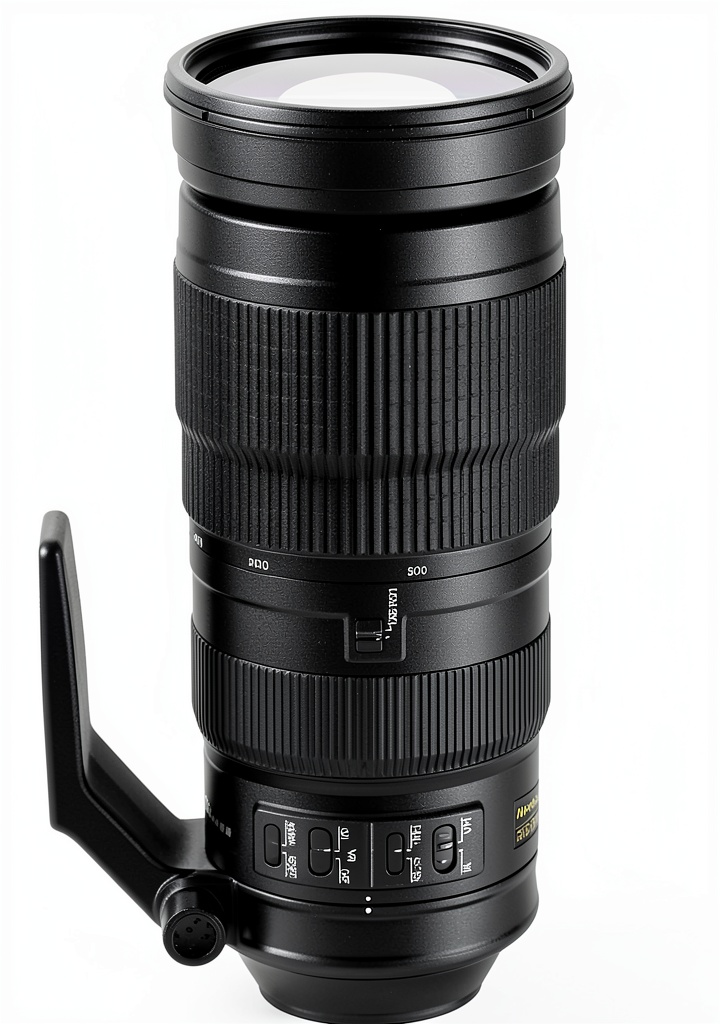 Super Telephoto Zoom Lens with lens hood attached, sitting on a camera bag in an outdoor setting” />
| Specification | Details |
|---|---|
| Focal Length | 200-500mm |
| Maximum Aperture | f/5.6 (constant) |
| Minimum Aperture | f/32 |
| Lens Construction | 19 elements in 12 groups (3 ED elements) |
| VR (Vibration Reduction) | Yes, up to 4.5 stops |
| Autofocus | Nikon Silent Wave Motor (SWM) |
| Focus Mode | Auto/Manual with manual override (M/A) |
| Filter Size | 95mm |
| Weight | Approx. 2300g (81.1 oz) |
| Compatibility | Nikon F-mount (FX and DX format) |
Real-World Performance & Feature Analysis
Design & Build Quality: The Field-Ready Tank
Picking up the Nikon 200-500mm for the first time, you immediately feel its purpose. This is not a delicate instrument. The barrel is primarily high-quality plastic over a metal mount and internal structure, making it durable without being excessively heavy. The zoom ring is wide and rubberized, requiring a firm but smooth throw to go from 200mm to 500mm. I’ve used this lens in light rain and dusty environments, and it’s never missed a beat. The tripod collar is a critical feature—shooting handheld for more than a few minutes is fatiguing, and the collar allows for a balanced setup on a monopod or tripod. One non-obvious pro tip: the tripod foot has an Arca-Swiss compatible groove, a welcome touch that saves you from needing an additional plate.
Optical Performance: Where It Really Shines
This is why you buy the lens. Wide open at f/5.6, the center sharpness is excellent across the zoom range. On a 45MP Nikon Z 7II, feathers on a distant bird are rendered with crisp detail. There’s some softness in the corners on a full-frame body, but for most wildlife and sports subjects, your subject is in the center anyway. Stopping down to f/8 makes the entire frame tack sharp. The VR system is the unsung hero. In one real-world test, I shot a perched owl at 500mm and 1/100s shutter speed—a recipe for blur without stabilization. The VR locked on, and the result was a perfectly sharp image. The trade-off is that the autofocus motor isn’t the fastest. It’s fine for predictable motion but can struggle with sudden, erratic movement like a bird changing direction mid-flight.
Ease of Use: The Handheld Compromise
Using the Nikon 200-500mm lens is a lesson in technique. Handholding is possible, but you need a high shutter speed (1/500s or faster) and solid posture to avoid camera shake, even with VR. The lens balances well on a Nikon D500 or D850, but on smaller bodies, it can feel front-heavy. The autofocus is quiet and accurate in good light, but in the low contrast of a forest understory, it can hunt. This is where the M/A manual override is essential—a quick tweak of the focus ring often gets it back on track faster than letting the motor struggle.
Pros & Cons
Pros:
- Exceptional sharpness at 500mm f/5.6, providing professional-level detail.
- Constant f/5.6 aperture ensures consistent exposure and AF performance.
- Highly effective VR system that enables sharp handheld shots in challenging light.
- Robust build quality that can withstand the rigors of outdoor photography.
- Excellent value compared to Nikon’s pro-level super-telephotos.
Cons:
- Heavy and bulky, requiring careful consideration for travel and mobility.
- Autofocus can be sluggish compared to newer lenses, especially in low light.
- 95mm filters are large and expensive if you need neutral density or polarizers.
- Noticeable focus breathing when focusing on closer subjects, which slightly reduces effective focal length.
Comparison & Alternatives
No lens exists in a vacuum. Your decision often comes down to the Nikon 200-500mm versus the popular third-party 150-600mm options. Here’s the real-world breakdown.
Cheaper Alternative: Sigma or Tamron 150-600mm f/5-6.3
The Trade-Off: The Sigma Contemporary and Tamron G2 150-600mm lenses offer more reach (600mm) for a similar or slightly lower price. They are also generally lighter. However, they use a variable aperture, meaning at 600mm, you’re at f/6.3. This slight difference can impact autofocus speed and accuracy on older DSLR bodies in low light. In my experience, the Nikon has a slight edge in sharpness at the long end wide open, but the Tamron G2’s autofocus is often faster and more sophisticated. Choose the Tamron/Sigma if: Weight is a primary concern, you need every millimeter of reach, and you’re using a modern camera body that can handle the f/6.3 aperture well.
Premium Alternative: Nikon 500mm f/5.6E PF ED VR
The Leap in Performance: This is the lens you upgrade to. The 500mm PF is a prime lens, meaning no zoom, but it uses Phase Fresnel elements to make it incredibly compact and light (around 1.5kg). The autofocus is significantly faster and quieter, and the optical performance is sublime. The catch? It costs over twice as much as the 200-500mm. Choose the 500mm PF if: You’re a serious wildlife photographer who needs the best possible performance in a portable package and the budget is not the primary constraint.
Buying Guide / Who Should Buy
Best for Beginners
For a beginner moving into wildlife photography, the Nikon 200-500mm is a fantastic, if demanding, tool. It will teach you proper technique—managing weight, using support, and panning. Pair it with a Nikon D7500 or Z50 (DX format) for an effective 750mm reach that’s great for birds. The consistent image quality will grow with you as your skills improve.
Best for Professionals
For a working pro who needs a reliable, sharp telephoto for predictable scenarios (e.g., perched wildlife, daytime sports), the 200-500mm is a excellent backup or secondary lens. Its optical quality is high enough for publication. However, for fast-paced, unpredictable action where autofocus speed is critical, a Nikon 400mm f/2.8 or the 500mm PF would be a better primary tool.
Not Recommended For
Avoid this lens if: Your primary photography involves a lot of hiking where every gram counts, you shoot primarily in dimly lit indoor venues, or you need a lens for casual travel photography. In these cases, a lighter variable-aperture zoom or a high-quality 70-200mm f/2.8 with a teleconverter might be more versatile.
FAQ
Is the Nikon 200-500mm f/5.6 worth it in 2026?
Absolutely. While newer lenses have emerged, the core optical performance of the 200-500mm remains competitive. Its value proposition is still very strong, especially for photographers invested in the Nikon F-mount ecosystem.
How does it perform on Nikon Z mirrorless cameras?
It works very well with the FTZ adapter. The autofocus performance is generally on par with, or sometimes even better than, on DSLRs thanks to the advanced AF systems in cameras like the Z8 and Z9. The in-body image stabilization (IBIS) on Z bodies also works in tandem with the lens’s own VR for even better stability.
Nikon 200-500mm vs. Tamron 150-600 G2: which is sharper?
At their shared apertures (e.g., 500mm f/5.6), the Nikon often has a slight edge in center sharpness. However, the Tamron offers more reach (600mm) and more advanced autofocus features. The difference isn’t night-and-day; it often comes down to prioritizing pure sharpness (Nikon) versus versatility and AF tech (Tamron).
Is the f/5.6 aperture fast enough for wildlife?
For most daytime wildlife photography, yes. You’ll need to keep your shutter speed high (1/1000s or faster) to freeze action, which often means bumping the ISO in anything but bright sun. The excellent VR helps for static subjects in lower light. For dawn/dusk shooting, you’ll be pushing your camera’s ISO performance.
What’s the minimum focusing distance?
It’s about 2.2m (7.2 ft), which is reasonably close for a super-telephoto. This allows for surprisingly frame-filling shots of larger insects, butterflies, or small details in nature.

 Dell OptiPlex 5070 Micro Computer Intel i7 Windows 11 Pro