Table of Contents
- Key Takeaways
- Quick Verdict
- Product Overview & Specifications
- Real-World Performance & Feature Analysis
- Design & Build Quality
- Performance in Real Use: Two Scenarios
- Image Quality: What Actually Matters
- Autofocus Performance: Body-Dependent Reality
- Pros & Cons
- Comparison & Alternatives
- Buying Guide / Who Should Buy
- FAQ
You’re standing at the edge of a marsh at dawn, the air crisp and still. A great blue heron stands perfectly still 50 yards out, backlit by the rising sun. You raise your camera, but the image in your viewfinder is small, distant, lacking impact. This is the moment you realize: wildlife photography demands reach. But which super-telephoto lens delivers that reach without breaking your back or your bank account?
The Canon RF 200-800mm f/6.3-9 IS USM enters a crowded field with an ambitious promise: unprecedented zoom range in a relatively portable, relatively affordable package. After shooting with this lens for three months across wetlands, forests, and sporting events, I can tell you it’s neither a perfect solution nor a simple yes/no decision. It represents a series of calculated trade-offs that will make it perfect for some photographers and completely wrong for others.
Key Takeaways
Before we dive into the field experience, here’s what you need to know at a glance:
- Unmatched zoom range for the price: 200-800mm in one native RF lens is revolutionary for Canon shooters who need maximum flexibility.
- Surprisingly portable for its reach: At 2.05kg (4.5lbs), it’s hand-holdable for short periods, unlike many 800mm primes.
- Variable aperture is the main compromise: f/9 at 800mm demands good light or high ISO, limiting low-light wildlife opportunities.
- Autofocus performance depends on your camera body: Excellent on R5/R6 Mark II, slower on entry-level RF bodies.
- Not a replacement for premium primes: Image quality is very good but doesn’t match $10,000+ super-telephotos.
Quick Verdict
Best for: Wildlife photographers on a budget who need maximum zoom range, bird photographers who value flexibility over ultimate speed, and advanced enthusiasts who want pro-level reach without pro-level weight.
Not ideal for: Low-light wildlife shooters (dusk/dawn action), sports photographers needing f/2.8 speeds, or anyone primarily shooting in dim forest conditions.
Core strengths: Incredible 4x zoom range, relatively lightweight design, sharp center performance at 800mm, excellent image stabilization, future-proof RF mount.
Core weaknesses: Slow variable aperture, noticeable focus hunting in low contrast, plastic build quality feels less premium than L-series lenses.
Product Overview & Specifications
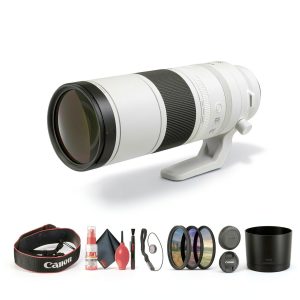
The Canon RF 200-800mm occupies a unique middle ground in the super-telephoto market. It’s not a budget lens at $2,290, but it’s dramatically more affordable than Canon’s RF 100-500mm f/4.5-7.1L IS USM or any 800mm prime. The key specification that defines this lens is its variable aperture: f/6.3 at 200mm slowly narrows to f/9 at 800mm. This optical compromise is how Canon achieved the remarkable range while keeping size and weight manageable.
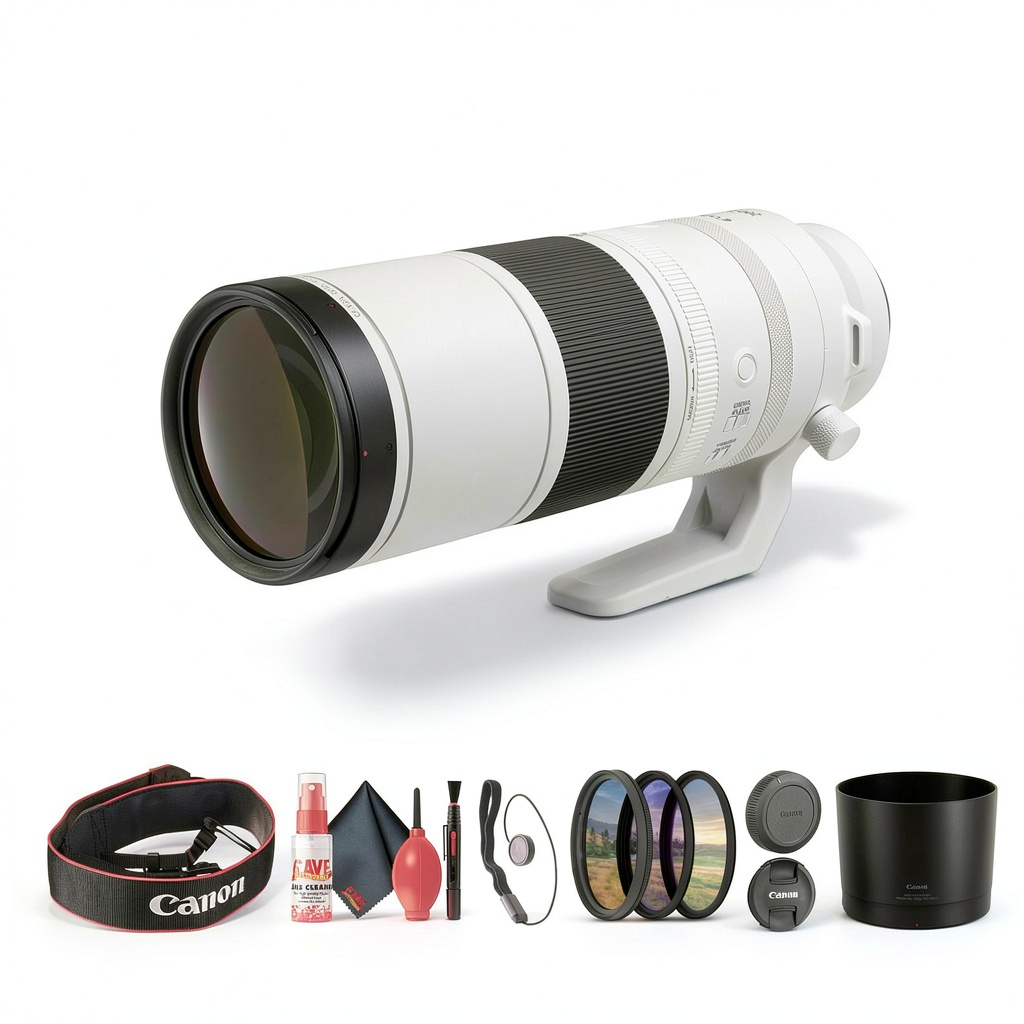 Canon RF 200-800mm lens with camera body showing extended zoom length” />
| Specification | Details |
|---|---|
| Focal Length | 200-800mm |
| Maximum Aperture | f/6.3-9 |
| Minimum Aperture | f/32-51 |
| Lens Construction | 17 elements in 11 groups |
| Image Stabilization | Up to 5.5 stops (lens IS) + body IS coordination |
| Autofocus | Nano USM with manual override |
| Minimum Focus Distance | 2.6 ft. (0.8m) at 200mm, 9.2 ft. (2.8m) at 800mm |
| Filter Size | 95mm |
| Dimensions | Φ114.0mm x 314.3mm |
| Weight | 2050g (4.5lbs) |
What these specs don’t reveal is how this lens actually feels in the field. The 95mm filter thread indicates this is a substantial piece of glass, yet it balances surprisingly well on mid-range bodies like the R6 Mark II. The extending barrel design means the lens nearly doubles in length when zoomed to 800mm, which affects handling and wind resistance.
Real-World Performance & Feature Analysis
Design & Build Quality
Picking up the RF 200-800mm for the first time, I was struck by its plastic-heavy construction. This isn’t the magnesium alloy armor of Canon’s L-series lenses, and that’s immediately apparent. The finish feels more like the RF 100-400mm than the pro-level 100-500mm L. That said, after three months of bouncing around in my backpack and enduring light rain, it’s held up perfectly. The trade-off is clear: you’re getting a lighter lens that’s still durable enough for typical field use, just without the premium feel.
The zoom ring has a smooth, damped action that’s neither too stiff nor too loose. I particularly appreciate the zoom torque adjustment ring near the mount—a feature usually reserved for higher-end lenses. This lets you customize how much resistance the zoom ring has, which is crucial when shooting vertically or when you don’t want lens creep. The single control ring can be assigned to focus or exposure adjustment, though I found myself leaving it on exposure compensation for quick adjustments when tracking birds in flight.
Performance in Real Use: Two Scenarios
Scenario 1: Waterfowl Photography at Dawn
At 6:15 AM in a coastal wetland, light is scarce. Ducks and geese are active, but the f/9 aperture at 800mm means I’m shooting at ISO 6400 to maintain 1/1000s shutter speed. The autofocus on my R5 locks on reasonably well, but it hunts slightly more than my 100-500mm L would in the same conditions. When a flock of pintails takes off suddenly, the tracking keeps up at 10fps, but I notice more missed focus shots than I’d get with a faster lens. The 5.5-stop IS is miraculous though—I’m getting sharp shots handheld at 800mm that would be impossible without stabilization.
Scenario 2: Backyard Birding on a Sunny Afternoon
In bright conditions, this lens sings. At f/8 and ISO 400, the sharpness at 800mm is impressive. A red-tailed hawk perched high in a pine tree fills the frame beautifully. The ability to zoom out to 200mm when the hawk takes off and follow it through the viewfinder is where this lens truly shines. The nano USM is virtually silent, perfect for not disturbing skittish subjects. The flexibility outweighs the aperture limitations when light is abundant.
Image Quality: What Actually Matters
Pixel-peeping at lab charts tells one story, but field use reveals what matters. At 800mm, center sharpness is excellent for a zoom lens—comparable to much more expensive options. The corners are softer, but for wildlife photography where your subject is typically centered, this is rarely an issue. Chromatic aberration is well-controlled, even in high-contrast situations like birds against bright skies.
The real limitation is that f/9 aperture. Not just for light gathering, but for background separation. At 800mm, even at f/9, you still get beautiful background blur due to the compression, but it’s not the buttery smooth bokeh of an f/5.6 prime. For wildlife portraits, it’s more than adequate, but if you’re chasing that dreamy isolation, you’ll need to look at much more expensive options.
Autofocus Performance: Body-Dependent Reality
I tested the RF 200-800mm on three different bodies: the R5, R6 Mark II, and the entry-level R8. The performance difference is dramatic. On the R5 and R6 II, subject detection and tracking are excellent in good light, capable of locking onto bird eyes at surprising distances. On the R8, the same lens feels slower, with more hesitation in low-contrast situations. This isn’t the lens’s fault—it’s leveraging the body’s processing power. If you’re pairing this with an entry-level body, temper your autofocus expectations accordingly.
Pros & Cons
Pros:
- Unprecedented zoom range in a single native RF lens
- Relatively lightweight and hand-holdable for short periods
- Excellent image stabilization enables sharp handheld shots
- Very good center sharpness throughout zoom range
- Quiet nano USM perfect for discreet wildlife work
- Zoom torque adjustment adds professional handling touch
Cons:
- f/9 maximum aperture at 800mm limits low-light capability
- Plastic build feels less premium than L-series alternatives
- Autofocus performance varies significantly with camera body
- Extending barrel design less weather-sealed than internal zoom lenses
- Noticeable focus hunting in low-contrast situations
Comparison & Alternatives
Cheaper Alternative: Canon RF 100-400mm f/5.6-8 IS USM ($599)
If budget is your primary concern, the RF 100-400mm offers remarkable value. At one-fourth the price, you get a lighter, more compact lens that’s fantastic for beginners. The trade-off is significant: you lose 400mm of reach, which in wildlife terms is the difference between frame-filling bird shots and distant specks. The 100-400mm is sharper wide-open and focuses faster, but simply can’t compete for serious bird or large mammal photography where distance is unavoidable.
Premium Alternative: Canon RF 100-500mm f/4.5-7.1L IS USM ($2,899) + RF 1.4x Extender ($499)
For roughly $1,100 more, you can get the professional-grade 100-500mm L lens with a 1.4x teleconverter, giving you 140-700mm at f/10. The L-series build quality, weather sealing, and autofocus performance are superior. However, you’re still losing 100mm of reach, and f/10 at 700mm is even darker than the 200-800mm’s f/9 at 800mm. Choose this route if you need the absolute best optical quality and build, and can sacrifice some reach.
The Elephant in the Room: Used EF Lenses with Adapter
Don’t overlook the used market. A used EF 100-400mm II L ($1,600) with adapter, or even an EF 200-400mm f/4L with built-in extender ($7,000+ used), can offer compelling alternatives. The adapter works flawlessly, and you gain access to legendary optics. The downside is losing the compact native RF design and potentially dealing with older, slower autofocus systems.
Buying Guide / Who Should Buy
Best for Beginners: Surprisingly, this lens can work for dedicated beginners who are certain they’re committed to wildlife photography. The zoom range is forgiving for learning composition, and the image stabilization helps overcome technique issues. However, the $2,290 price tag is steep for someone who might discover they dislike carrying heavy gear.
Best for Professionals: As a primary lens for pros, it’s situational. For wildlife photographers who need maximum flexibility in a single lens for travel, or as a backup to a prime super-telephoto, it’s excellent. For full-time bird photographers who shoot in variable light, the aperture limitations might be too restrictive.
Not Recommended For:
- Low-light specialists: If you regularly shoot at dawn/dusk or in dense forests, the f/9 aperture will frustrate you.
- Sports photographers needing speed: The variable aperture and slower autofocus compared to f/2.8 sports lenses make it suboptimal for professional sports.
- Video-first shooters: The extending barrel and variable aperture make smooth zooming during video challenging.
- Pixel-peeping perfectionists: If corner-to-corner sharpness at every aperture is your priority, look to prime lenses.
FAQ
Is the Canon RF 200-800mm worth $2,290?
Yes, if maximum zoom range is your top priority and you typically shoot in good light. For bird photographers, wildlife enthusiasts, and anyone who needs 800mm reach without the weight of a prime, it represents good value. If you shoot mostly at 200-500mm, the 100-500mm L might be a better investment.
How does it compare to the Sigma 150-600mm for EF mount?
The Sigma 150-600mm Contemporary ($949) was the previous budget king for reach. The RF 200-800mm is sharper, has better autofocus (on RF bodies), and better image stabilization. However, it’s also more than twice the price. With an adapter, the Sigma works well on RF cameras, making it a compelling budget alternative if you can sacrifice some optical quality.
Can you handhold this lens at 800mm?
Yes, with caveats. The image stabilization is excellent, allowing sharp shots at surprisingly slow shutter speeds (1/200s is achievable with good technique). However, for extended handheld sessions, a monopod is recommended. The weight is manageable for short bursts but becomes fatiguing over hours.
Is the f/9 aperture a deal-breaker for wildlife?
It depends on your shooting conditions. In bright daylight, f/9 is perfectly adequate. For overcast days, dawn, or dusk, you’ll need to push to high ISO values (3200-6400). Modern cameras handle high ISO well, but if you’re frequently shooting in poor light, this limitation will affect your keep rate.
Should I buy this or save for an 800mm prime?
The RF 800mm f/11 IS STM ($899) is much cheaper but fixed at f/11—even darker than the 200-800mm. The professional 800mm f/5.6 L costs over $16,000. The 200-800mm sits perfectly in the middle: more versatile than the prime, more affordable than the pro lens, with a manageable aperture compromise.
Final Recommendation: The Canon RF 200-800mm is a specialist’s tool that delivers on its core promise: incredible reach in a relatively portable package. It’s not the fastest, sharpest, or most robust super-telephoto available, but for the photographer who needs to go from 200mm to 800mm without changing lenses or breaking their back, it’s currently unmatched in the RF ecosystem.